" height="28.235345940422295px" id="q9sQ2kzlE" transform="translate(0 0.38)" width="29.999999345730185px"/></svg>)

Rental System Enhancement
Welcome to Chinatown rental workflow
Rental System Enhancement
Welcome to Chinatown rental workflow
Rental System Enhancement
Welcome to Chinatown rental workflow
Redesigning WtC’s rental workflow to help small businesses book community spaces with more clarity and efficiency.
Redesigning WtC’s rental workflow to help small businesses book community spaces with more clarity and efficiency.
• Reduced communication overhead across stakeholders
• Reduced communication overhead across stakeholders
• Improved task completion from 60% to 100%
• Improved task completion from 60% to 100%
• Enabled 40% faster and more confident planning decisions
• Enabled 40% faster and more confident planning decisions
Role
Role
Solo Product Designer
Solo Product Designer
Timeline
Timeline
11/2025 - 12/2025
11/2025 - 12/2025
Team
Team
1 Web Designer, 3 Stakeholders, Marketing Team (WtC)
1 Web Designer, 3 Stakeholders, Marketing Team (WtC)
Contribution
Contribution
XFN collaboration, User research, Design reviews, Interviews, Prototyping
XFN collaboration, User research, Design reviews, Interviews, Prototyping


Problem?
Problem?
The current workflow creates delays, repeated back-and-forth communication, and unclear information throughout the rental process.
The current workflow creates delays, repeated back-and-forth communication, and unclear information throughout the rental process.
The current workflow creates delays, repeated back-and-forth communication, and unclear information throughout the rental process.
Welcome to Chinatown’s rental system had evolved organically over time. Coordination relied heavily on manual communication and individual memory. As demand increased, operational friction became visible.
Welcome to Chinatown’s rental system had evolved organically over time. Coordination relied heavily on manual communication and individual memory. As demand increased, operational friction became visible.

"We are looking for a sustainable solution that can help streamline our event rental communications."
"We are looking for a sustainable solution that can help streamline our event rental communications."
"We are looking for a sustainable solution that can help streamline our event rental communications."
Research
Research
Through interviews with stakeholders and clients, we uncovered:
Through interviews with stakeholders and clients, we uncovered:
Through interviews with stakeholders and clients, we uncovered:
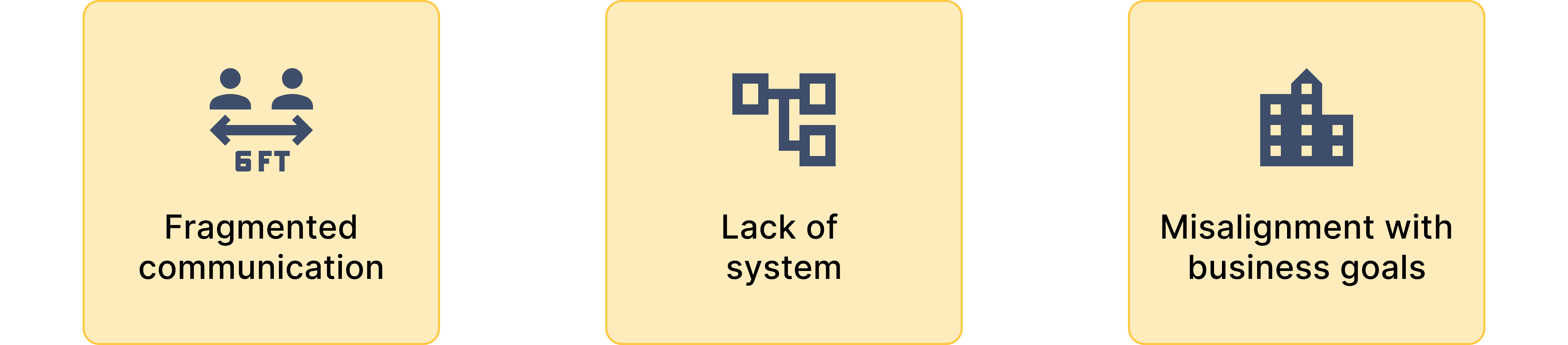
• This wasn’t a UI problem. It was a systems problem.
• This wasn’t a UI problem. It was a systems problem.
Instead of adding more interface layers, the focus shifted toward fragmented communication, unclear workflows, and operational misalignment across the rental process.
Instead of adding more interface layers, the focus shifted toward fragmented communication, unclear workflows, and operational misalignment across the rental process.
Core Issue?
Core Issue?
The rental process relied on repeated manual coordination instead of a shared system.
The rental process relied on repeated manual coordination instead of a shared system.
The rental process relied on repeated manual coordination instead of a shared system.
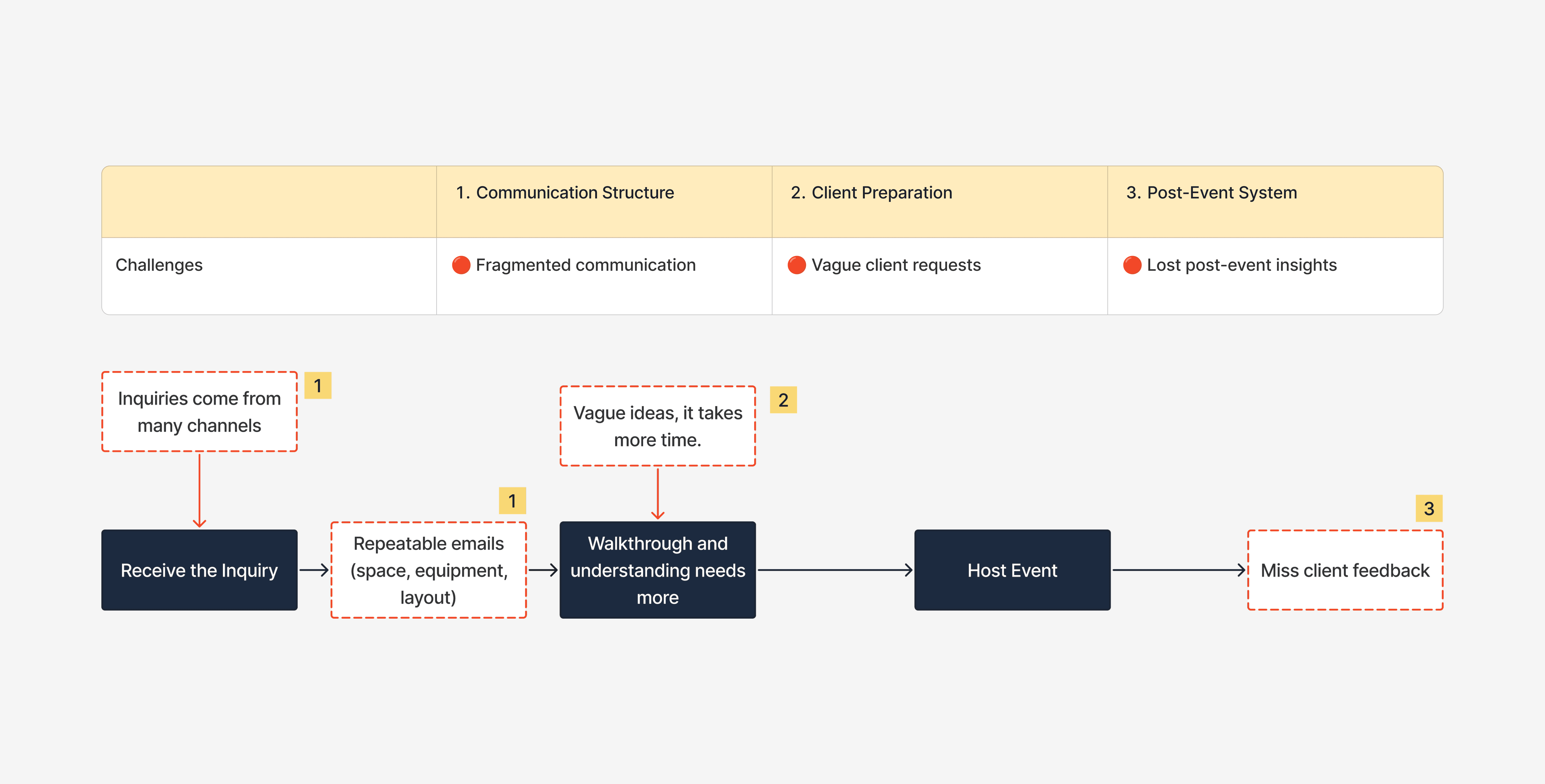
After a deep interview with Jeff, WtC's event manager, who handles end-to-end rental communication, I mapped the workflow and identified three key breakdown points:
After a deep interview with Jeff, WtC's event manager, who handles end-to-end rental communication, I mapped the workflow and identified three key breakdown points:
• Rental information was scattered across different channels.
• Rental information was scattered across different channels.
• Clients often didn't know what information to provide upfront.
• Clients often didn't know what information to provide upfront.
• Feedback wasn't captured for future improvements.
• Feedback wasn't captured for future improvements.
Goal
Goal
The goal was to create a clearer and more scalable rental workflow that reduced communication overhead while supporting WtC’s long-term community operations.
The goal was to create a clearer and more scalable rental workflow that reduced communication overhead while supporting WtC’s long-term community operations.
Design Process
Design Process
Why did I decide to focus on pre-event stages?
Why did I decide to focus on pre-event stages?
Why did I decide to focus on pre-event stages?
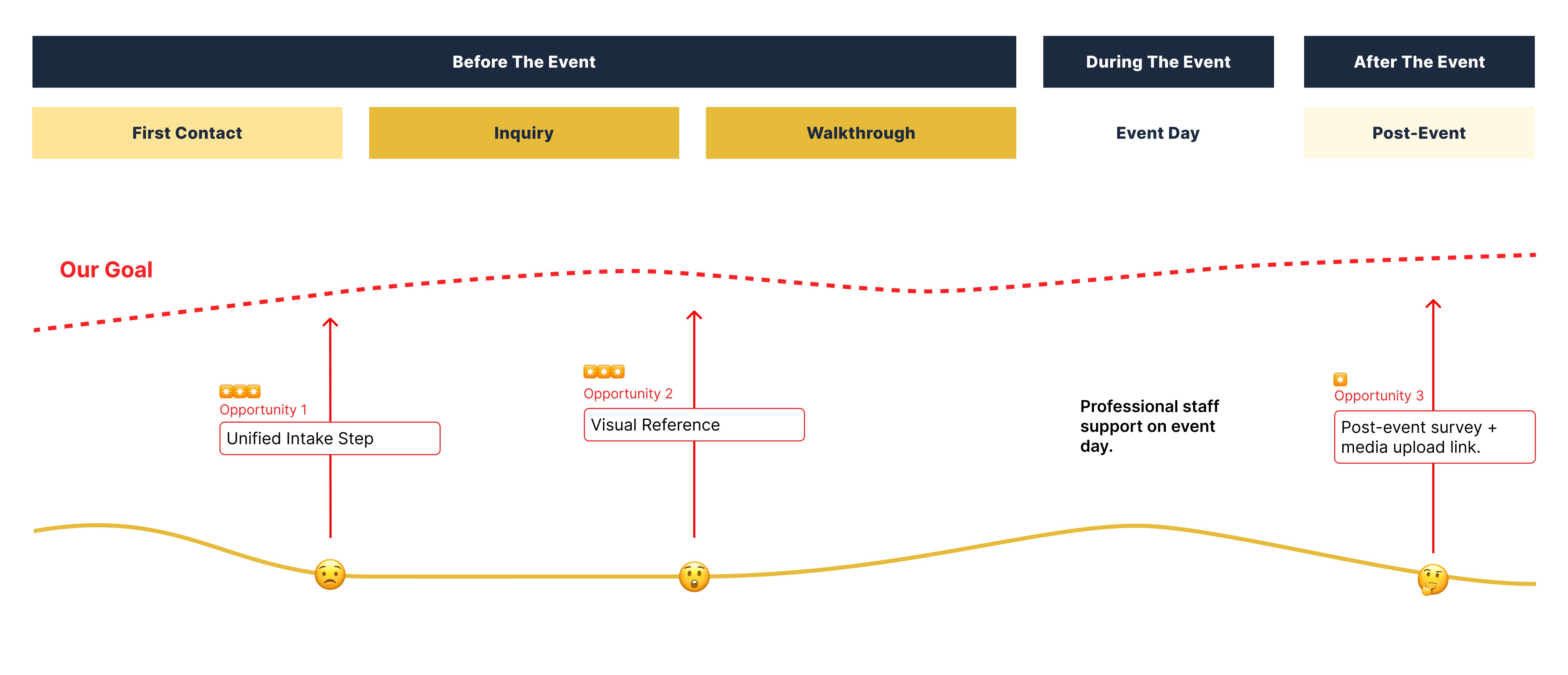
Breakdowns originate in how client inputs are captured and structured in the early stages. For the timeline constraints, by focusing on the pre-event stages, the design addresses the root cause rather than downstream symptoms.
Breakdowns originate in how client inputs are captured and structured in the early stages. For the timeline constraints, by focusing on the pre-event stages, the design addresses the root cause rather than downstream symptoms.
• Structuring the intake process
• Structuring the intake process
• Providing clear visual references
• Providing clear visual references
Design Process
Why not fully automate the pre-event experience?
Why not fully automate the pre-event experience?
Why not fully automate the pre-event experience?
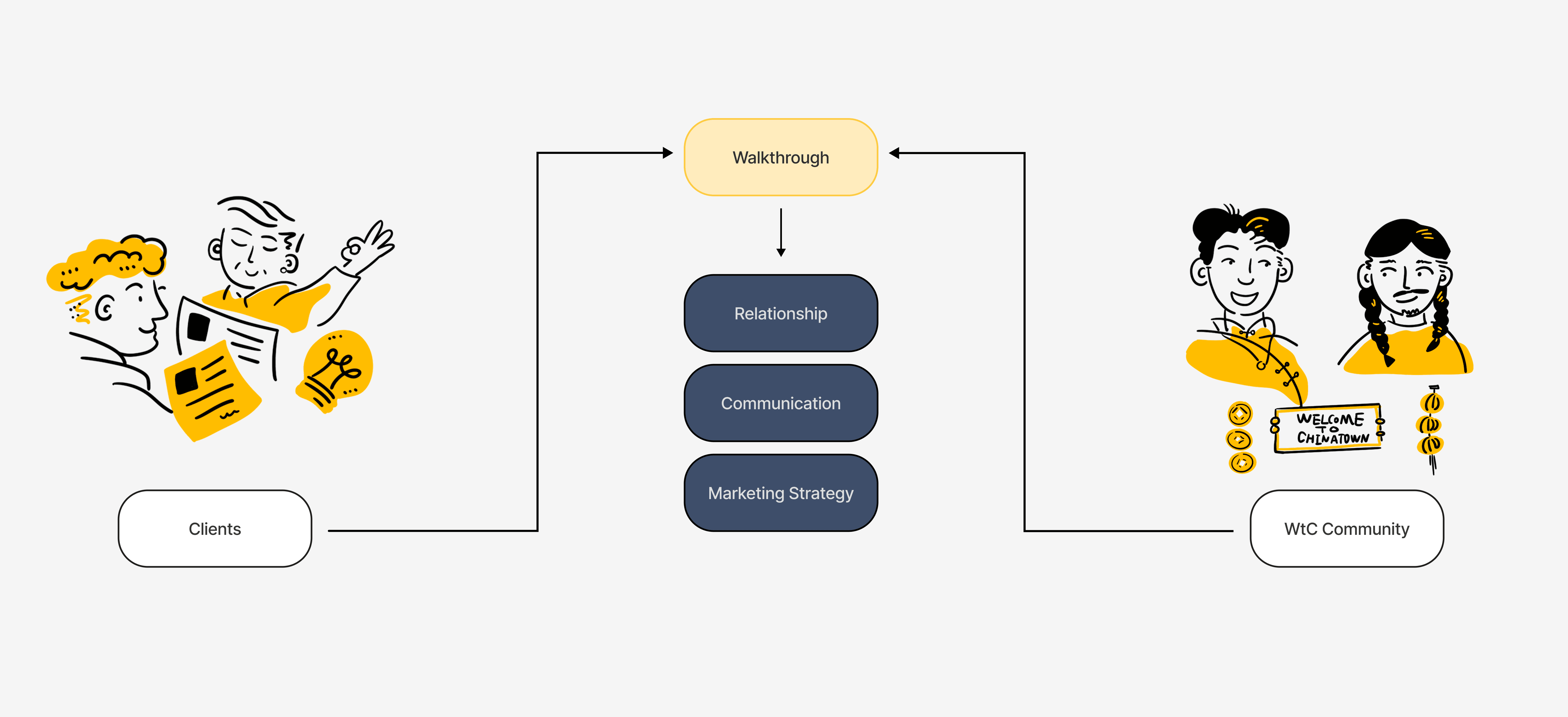
WtC’s value is rooted in community and in-person connection. Instead of an automated process, I kept the walkthroughs to provide spatial experience and expert guidance, using the system to reduce friction and reserve in-person time for high-value conversations and marketing strategy for business.
WtC’s value is rooted in community and in-person connection. Instead of an automated process, I kept the walkthroughs to provide spatial experience and expert guidance, using the system to reduce friction and reserve in-person time for high-value conversations and marketing strategy for business.
Here is the new rental system!
Here is the new rental system!
Here is the new rental system!
Design Solution
Design Solution
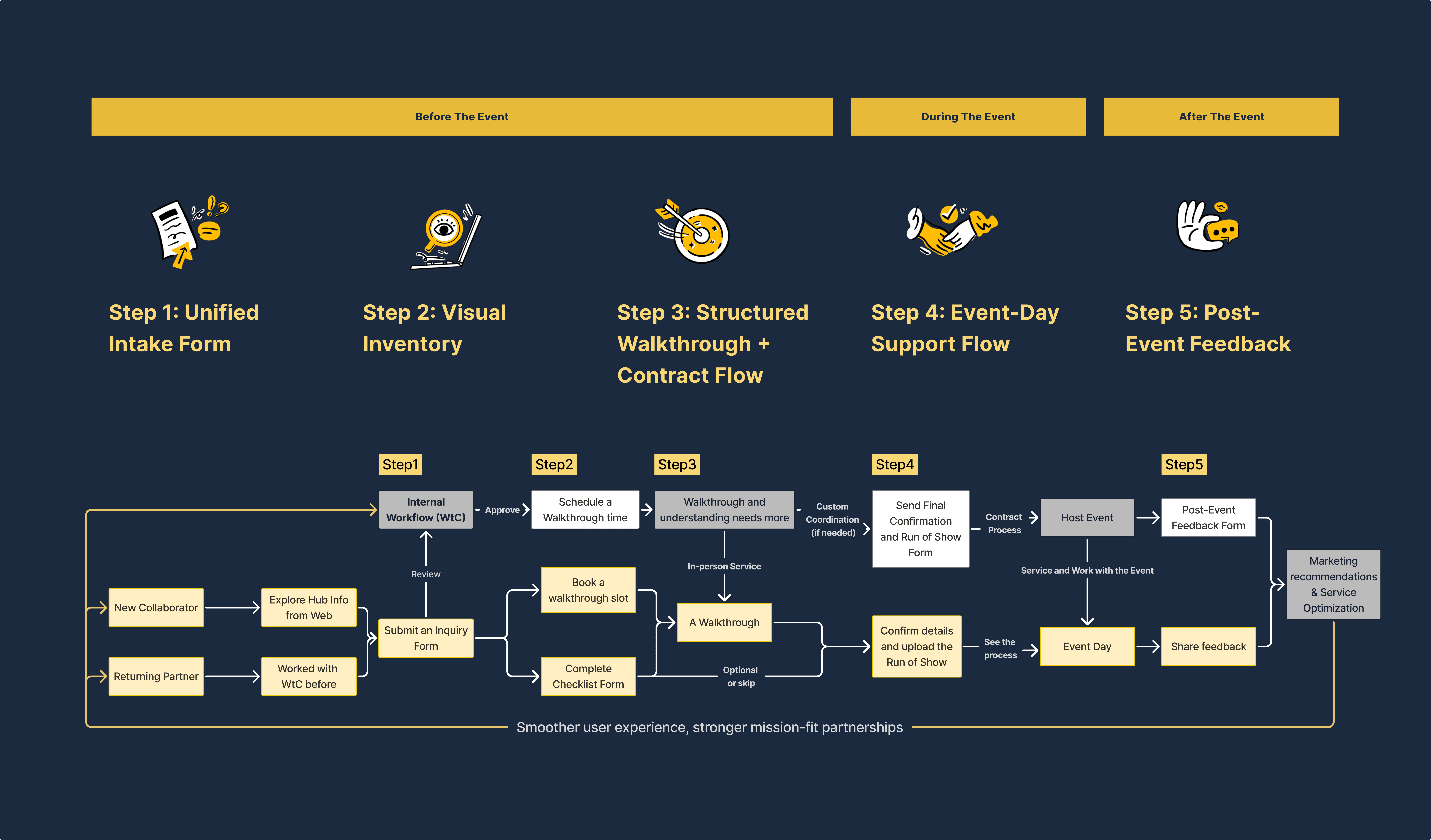
A 5-Step Rental Workflow
A 5-Step Rental Workflow
A 5-Step Rental Workflow
Q: How can the rental process feel more structured and predictable?
Q: How can the rental process feel more structured and predictable?
I proposed a 5-step rental system that front-loads clarity, reduces staff follow-ups, and creates a learning loop.
I proposed a 5-step rental system that front-loads clarity, reduces staff follow-ups, and creates a learning loop.
A Unified Intake Step
A Unified Intake Step
A Unified Intake Step

Visual Website Experience
Visual Website Experience
Visual Website Experience
Q: How can we make rental information easier to understand?
Q: How can we make rental information easier to understand?
Based on stakeholder feedback, pricing details, rules, and space references were reorganized with pictures to make information easier to browse. (Link to the Information Architecture)
Based on stakeholder feedback, pricing details, rules, and space references were reorganized with pictures to make information easier to browse. (Link to the Information Architecture)

Testing
Testing
Through 6 usability tests with staff members and clients, I iterated on the rental system to align with business goals while ensuring feasibility within technical constraints.
Through 6 usability tests with staff members and clients, I iterated on the rental system to align with business goals while ensuring feasibility within technical constraints.
A Unified Intake Step
A Unified Intake Step
Visual Website Experience
Visual Website Experience
Outcomes
Outcomes
Validated by stakeholder feedback and client review, the redesigned system:
Validated by stakeholder feedback and client review, the redesigned system:
• Reduced back-and-forth
• Reduced back-and-forth
• Increased team confidence
• Increased team confidence
• Enabled scalability
• Enabled scalability
40%
40%
faster planning decisions
faster planning decisions
60% → 100%
60% → 100%
task completion
task completion
Reflection
Reflection
The value of early stakeholder alignment.
The value of early stakeholder alignment.
Early conversations with the team helped uncover operational constraints and shaped more realistic design decisions.
Early conversations with the team helped uncover operational constraints and shaped more realistic design decisions.
Next step
Next step
For future iterations, we would explore automated scheduling to further reduce manual coordination while remaining aligned with the team’s operational capacity.
For future iterations, we would explore automated scheduling to further reduce manual coordination while remaining aligned with the team’s operational capacity.
I’m Kefan! Glad we could meet here.
Why don’t we collaborate, coffee chat or learn more? So let's connect!
© Kefan Shi, 2026



I’m Kefan! Glad we could meet here.
Why don’t we collaborate, coffee chat or learn more? So let's connect!
© Kefan Shi, 2026
I’m Kefan! Glad we could meet here.
Why don’t we collaborate, coffee chat or learn more? So let's connect!
© Kefan Shi, 2026